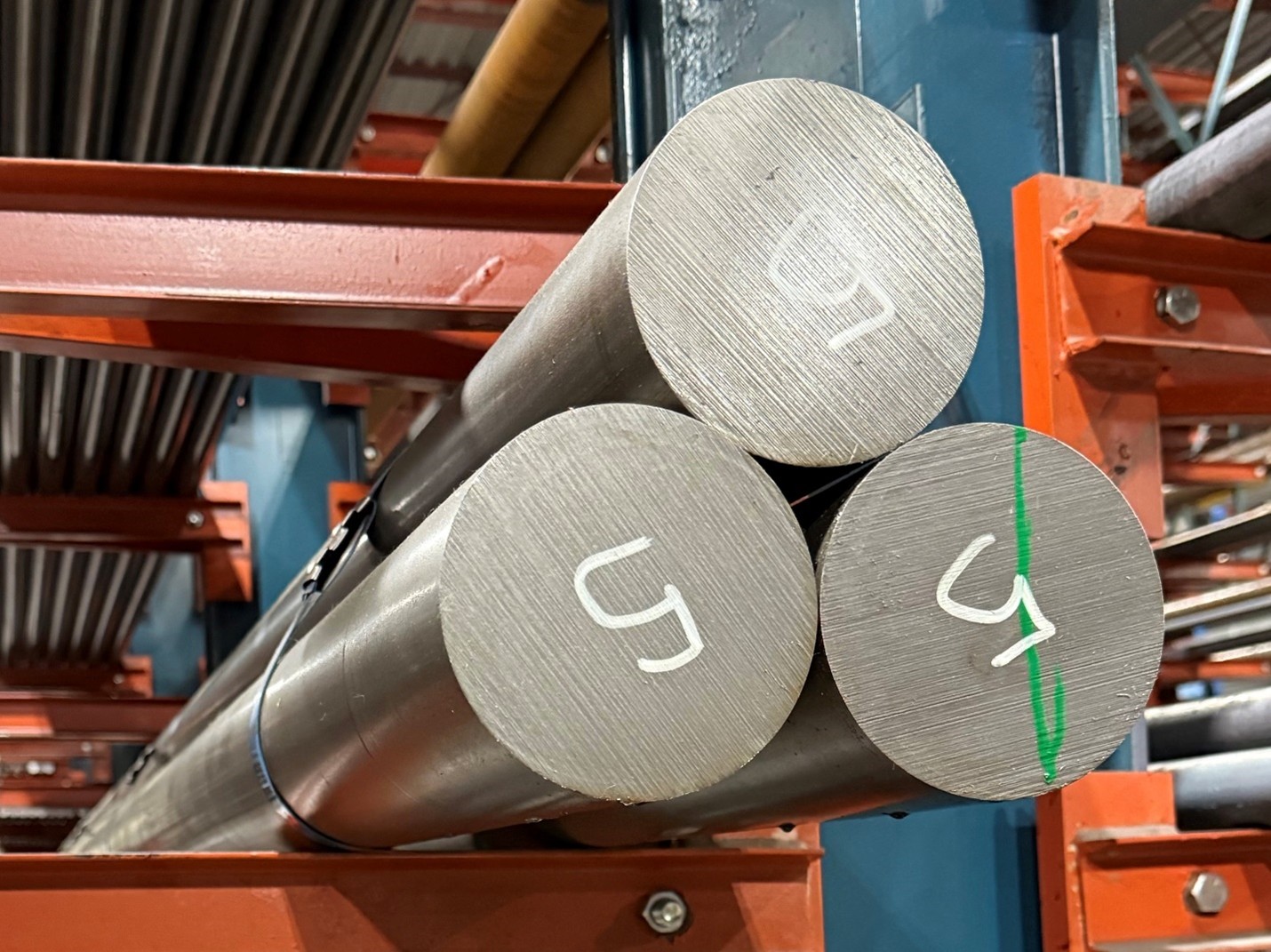
C1018 Cold Drawn Flats, Squares, Rounds (ASTM A108)
The term C1018 Cold Drawn steel refers to one of the most widely used and versatile forms of low-carbon steel in the world.
It is highly valued for its excellent machinability, good weldability, and improved strength over its hot-rolled counterpart.
Chemical Composition (Typical Range):
- Carbon (C): 0.15%–0.20% (Low carbon content makes it soft and ductile.)
- Manganese (Mn): 0.60%–0.90% (Higher than other mild steels like 1020, which improves the core properties for case hardening and boosts machinability.)
Key Characteristics:
- Excellent Machinability: Due to its consistent chemistry and structure, it is considered a free-machining grade among carbon steels.
- Good Weldability: The low carbon content allows it to be easily welded using almost all standard methods without the need for pre-heating or post-weld heat treatment in most cases.
- Case Hardenable: It responds very well to carburizing (case hardening) to create a hard, wear-resistant surface while maintaining a soft, tough, and ductile core.
Cold drawn refers to the manufacturing process used to finish the bar:
- A hot-rolled steel bar is pulled through a die at room temperature (below the steel's recrystallization point).
- This process reduces the bar's cross-sectional area and strain-hardens the material.
The cold drawing process provides three major benefits:
- Increased Mechanical Properties: The cold working significantly increases the yield and tensile strength compared to the original hot-rolled material.
- Superior Surface Finish: It results in a smooth, bright, and clean surface, reducing or eliminating the need for grinding or other finishing operations.
- Tighter Dimensional Tolerances: The bars achieve better straightness and more precise dimensional control conforming to ASTM A108 specifications.
C1018 Cold Drawn steel is primarily used for components that require moderate strength combined with excellent machinability and a smooth finish.
Precision Machined Parts
- Shafts, Axles, Pins, Dowels
- Bushings, Couplings, Spindles
- Studs, Bolts, and other Fasteners
Carburized Parts
- Gears, Pinions, Worms, and Ratchets (where a hard, wear-resistant surface is needed over a tough core).
General Fabrication
- Structural components, brackets, and ornamental work where welding and forming are required.
Comparison CD C1018 vs CD 4140
| Feature | C1018 Cold Drawn | 4140 Cold Drawn |
|---|---|---|
| Grade Type | Low-Carbon (Mild) Steel | Alloy Steel (Chromium-Molybdenum) |
| Carbon Content | Low (approx. 0.18%) | Medium (approx. 0.40%) |
| Yield Strength (Typical CD) | Moderate (~370 MPa / 54 ksi) | High (~415 MPa / 60 ksi) |
| Hardness (Typical CD) | Low (HB ~130) | Medium (HB ~200) |
| Heat Treatment | Only Case Hardening (Carburizing) | Through-Hardenable (Quenching & Tempering) |
| Machinability | Excellent (High speed, long tool life) | Moderate (Requires tougher tools/slower speeds) |
| Weldability | Excellent (No preheat typically required) | Moderate (Requires pre- and post-weld heat treatment to prevent cracking) |
| Cost | Lower (Common, general-purpose) | Higher (Alloy steel) |
Core Differences
- Strength and Hardenability
- 4140 is superior for strength. It contains chromium (Cr) and molybdenum (Mo), which are powerful alloying elements. In its quenched and tempered condition, 4140 can achieve tensile strengths more than double that of C1018.
- Heat Treatment: This is the most significant difference.
- C1018 cannot be hardened throughout due to its low carbon content. It is only suitable for case hardening (carburizing) to achieve a hard surface over a soft, tough core (e.g., for gears).
- 4140 is a through-hardening steel, meaning it can be heat-treated (quenched and tempered) to achieve uniform high strength and hardness deep into its cross-section (e.g., for heavy-duty shafts).
- Machinability and Weldability
- C1018 is superior for ease of processing. Due to its low carbon content and relatively high manganese content, C1018 is one of the most free-machining carbon steels available, leading to lower machining costs and faster cycle times.
- Weldability: C1018 is easily welded with minimal preparation. 4140 requires careful procedures, specifically pre-heating and post-weld stress relief or tempering. This helps avoid cracking and maintains adequate strength and ductility in the weld zone.
Request a Quote
Please click on the link below to email a request for quote or call one of our customer representatives at 1.888.649.9911
Request a Quote