4140 Heat Treated Stress Relieved Hot Rolled Round bars (ASTM A29, A193-B7, ASTM A322, ASTM A434)
The term 4140 Heat Treated Stress Relieved describes an alloy steel product that combines three specific manufacturing processes to deliver high strength and toughness with improved dimensional stability.
This is a premium, ready-to-use structural steel condition often specified for heavy-duty components.
Breakdown of the Specification
4140 Steel Alloy
- Type: Medium-carbon Chromium-Molybdenum (Cr-Mo) alloy steel.
- Purpose: The Cr and Mo alloying elements provide excellent hardenability, allowing the material to achieve high strength and superior wear resistance after heat treatment.
- Applications: Ideal for highly stressed parts like shafts, gears, axles, high-strength bolts, and heavy-duty machinery components.
Hot Rolled (HR)
- Process: The steel is rolled into its final shape while above its recrystallization temperature.
- Characteristics:
- Surface Finish: Rougher surface with residual mill scale.
- Tolerances: Less precise dimensional tolerances compared to cold-drawn (CD) bars.
- Cost: Generally, less expensive than CD bars due to less processing.
Heat Treated (Quenched and Tempered)
- Process: The "Heat Treated" designation, in this context for 4140, almost universally means Quenched and Tempered (Q&T). This is the primary method used to give 4140 its high strength.
- Hardening (Quenching): Heating to a high temperature (austenitizing), then rapidly cooling in oil to form a hard, but brittle, martensitic structure.
- Toughening (Tempering): Reheating the steel to an intermediate temperature to reduce brittleness and increase toughness while maintaining high strength.
- Result: The bar is supplied in a pre-hardened condition, typically in the 26–32 Rockwell C (HRC) hardness range (approx. 270–340 Brinell), ready for final machining.
Stress Relieved (SR)
- After the final heat treatment (Q&T) and subsequent mechanical straightening, the bar is reheated to a temperature slightly below the tempering temperature and held for a period before cooling slowly.
- This process is crucial to remove the residual internal stresses introduced by the initial quenching and, more importantly, the straightening process following the Q&T treatment.
- This minimizes the risk of warping, cracking, or movement during subsequent machining operations, which is a major advantage for parts requiring precision.
Typical Mechanical Properties
The Q&T/SR condition significantly elevates the mechanical properties of the bar:
| Property | Typical Value (Imperial) | Typical Value (Metric) |
|---|---|---|
| Tensile Strength | 130,000 – 160,000 psi | 900 – 1100 MPa |
| Yield Strength | 105,000 – 135,000 psi | 725 – 930 MPa |
| Hardness (Brinell) | 269 – 341 BHN | 269 – 341 BHN |
| Rockwell Hardness | 26 – 34 HRC | 26 – 34 HRC |
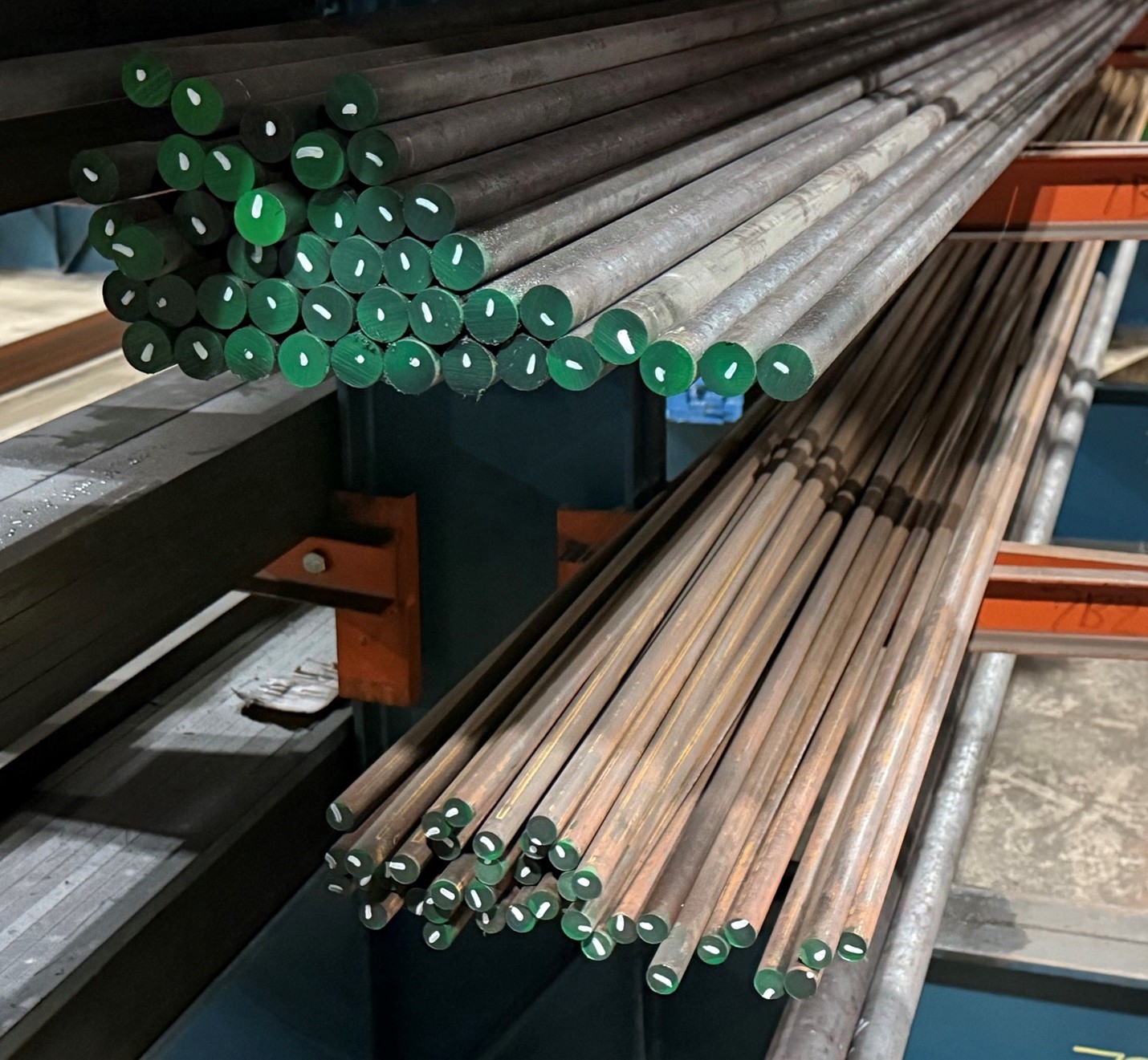
Hot Rolled Bars
-
Size Range:
3/4" to 12” diameter
Request a Quote
Please click on the link below to email a request for quote or call one of our customer representatives at 1.888.649.9911
Request a Quote