4340 Quenched & Tempered Hot Rolled bars (ASTM A29, ASTM A304, ASTM A322, ASTM A434)
The term 4340 Quenched & Tempered Hot Rolled steel bars defines a high-performance, ultra-high-strength alloy steel product that is supplied in its final, hardened condition. This material is primarily chosen for critical, heavily stressed components due to its superior toughness and hardenability, especially in large sections.
AISI 4340 is a medium-carbon, nickel-chromium-molybdenum alloy steel. It belongs to the high-strength, low-alloy (HSLA) steel family and is significantly tougher than 4140 steel, primarily due to the addition of Nickel (Ni).
- Key Alloying Difference (vs. 4140): The substantial Nickel content (1.65%–2.00%) enhances fracture toughness and ductility, particularly at low temperatures, and improves the steel's ability to harden uniformly (hardenability) throughout a larger cross-section.
- Chemical Composition (Key Elements):
- Carbon (C): 0.37%–0.43%
- Nickel (Ni): 1.65%–2.00%
- Chromium (Cr): 0.70%–0.90%
- Molybdenum (Mo): 0.20%–0.30%
- Applications: It is used for the most demanding applications in aerospace and heavy equipment, such as aircraft landing gear, heavy-duty shafts, high-performance gears, and large axles.
The Quenched & Tempered (Q&T) condition means the material is supplied pre-hardened and ready for final machining.
- Quenching (Hardening): The bar is heated to its critical temperature (austenitizing) and rapidly cooled, typically in oil, to form a hard, brittle structure (martensite).
- Tempering (Toughening): The hardened bar is then reheated to a specific lower temperature and held to reduce brittleness, thereby restoring ductility and toughness while maintaining high strength.
The Quenched & Tempered condition provides 4340 outstanding mechanical properties, making it an ultra-high-strength steel.
Hot Rolled indicates that the bars were shaped at high temperatures (above the recrystallization temperature).
- Surface and Tolerance: Hot Rolled bars have a characteristic rough, scaled surface and looser dimensional tolerances compared to cold-drawn bars.
Typical Mechanical Properties (Q&T)
The specific properties can vary depending on the exact tempering temperature and ruling section size, but the typical ranges for the Q&T condition are:
| Property | Typical Value (Imperial) | Typical Value (Metric) |
|---|---|---|
| Tensile Strength | 142,000 – 160,000 psi | 980 – 1100 MPa |
| Yield Strength | 123,000 – 145,000 psi | 850 – 1000 MPa |
| Hardness (Rockwell C) | 28 – 34 HRC | 28 – 34 HRC |
| Toughness | Excellent | Excellent |
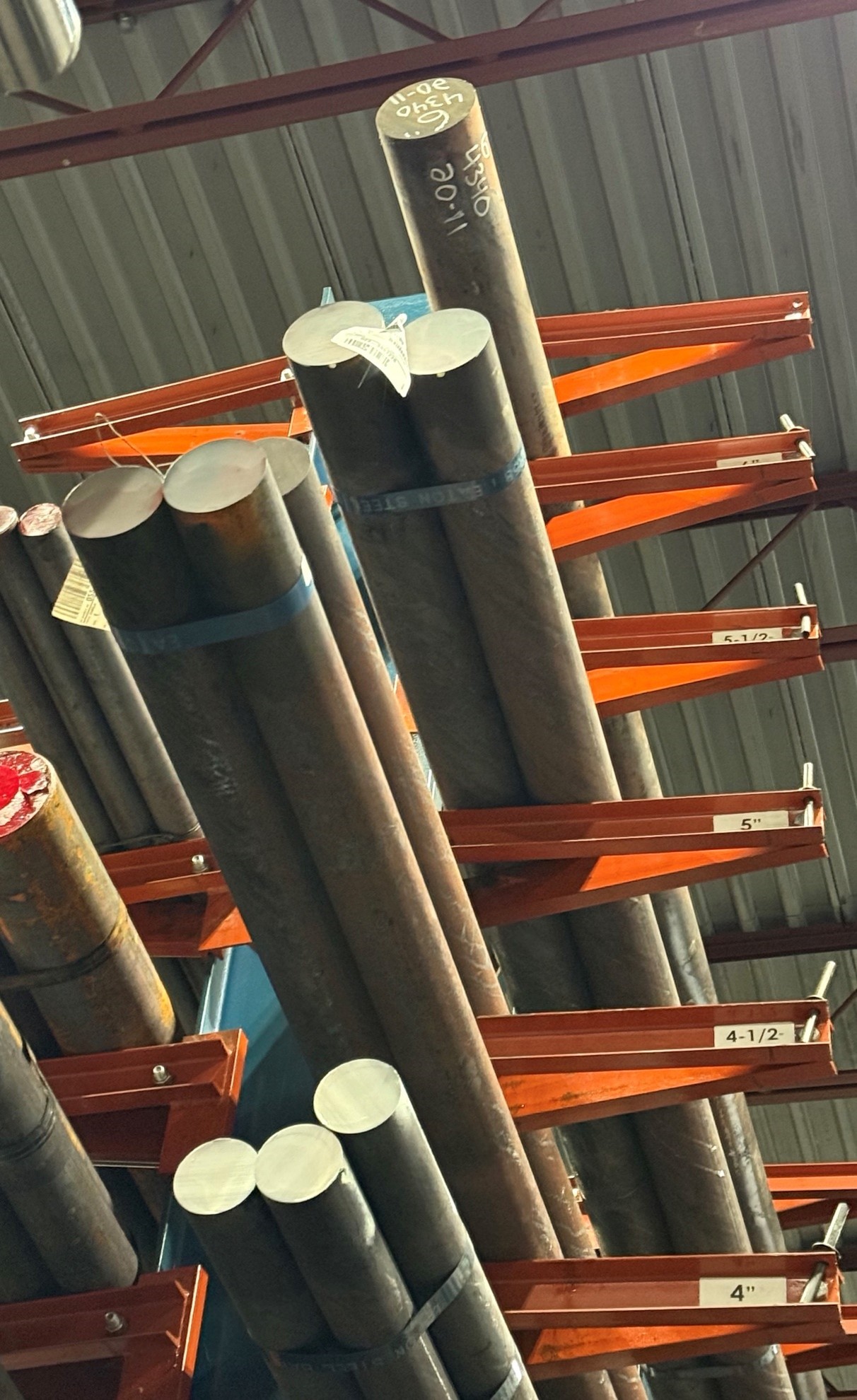
Hot Rolled Bars
-
Size Range:
2-1/2" to 9” diameter
Request a Quote
Please click on the link below to email a request for quote or call one of our customer representatives at 1.888.649.9911
Request a Quote